Choosing between a rain boots manufacturer and supplier is an important sourcing decision for importers, distributors, wholesalers, and footwear brands. The right choice depends on more than whether a company operates a factory. Buyers also need to consider product categories, customization requirements, order quantities, quality control, and long-term supply arrangements.
A manufacturer may offer direct access to production and product development, while a sourcing supplier may coordinate products from one or more factories. However, these roles can overlap, and neither business model automatically guarantees better pricing, quality, or service.
This guide explains how to compare rain boot manufacturers and suppliers, when direct manufacturing relationships may be useful, and what B2B buyers should verify before placing OEM, private-label, or bulk orders.
1. What Is the Difference Between a Rain Boots Manufacturer and Supplier?
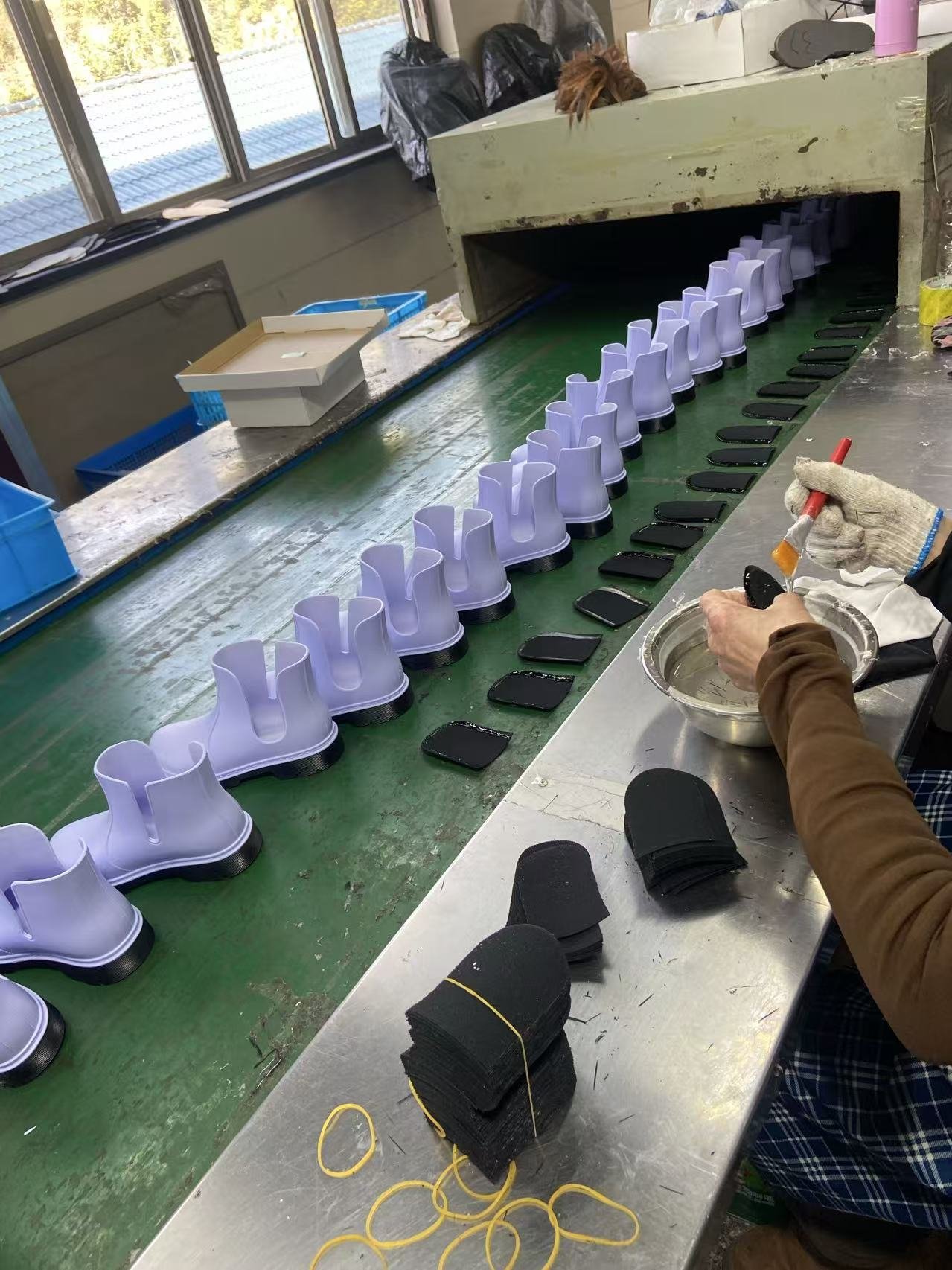
A rain boots manufacturer is a company that carries out manufacturing operations to produce rain boots. Its responsibilities may include production planning, materials, tooling, assembly or molding, finishing, and quality control, depending on the product and factory.
A rain boots supplier is a broader term for a business that supplies rain boots to customers. A supplier may be a manufacturer, a trading company, a distributor, or a sourcing organization working with external factories.
For B2B buyers, the distinction is not always as simple as factory versus middleman. A manufacturer may also supply products made by partners, while a sourcing supplier may have well-established systems for sample development, quality inspection, and export coordination.
The key questions are:
- Who manufactures the specific rain boots being quoted?
- Who controls the product specifications and tooling?
- Who manages samples and production changes?
- Who is responsible for inspection and quality issues?
- Who manages repeat orders and product consistency?
Understanding these responsibilities is more useful than relying only on how a company describes itself.
2. Why Product Category Matters When Choosing a Rain Boots Supplier
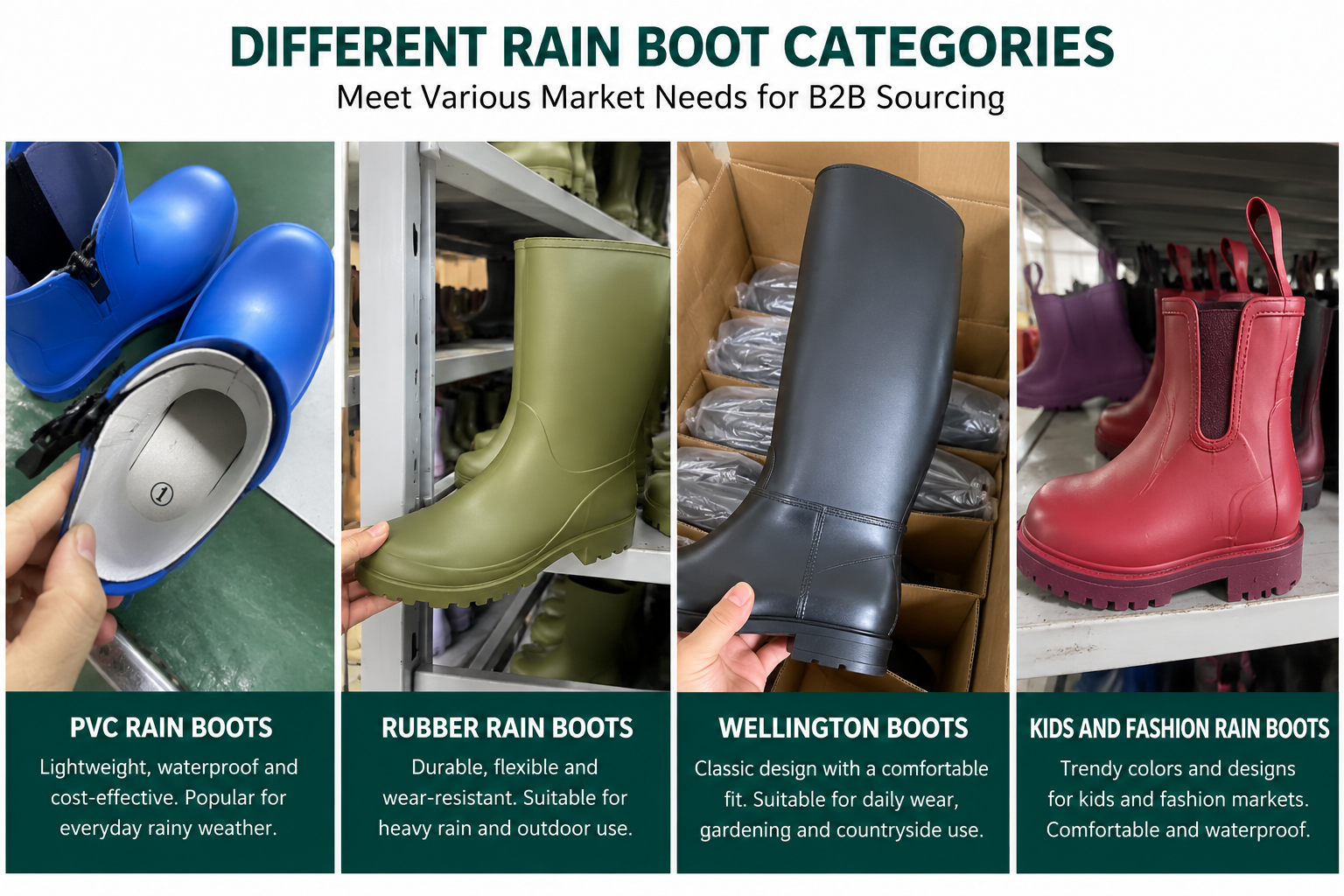
Rain boots cover several product categories with different materials, constructions, applications, and manufacturing requirements.
PVC Rain Boots
PVC rain boots are commonly considered for waterproof footwear programs where buyers need to evaluate molded construction, product design, colors, size ranges, and bulk production requirements.
When sourcing this category, buyers should confirm the manufacturer's experience with the required PVC boot construction, molds, product specifications, and customization options.
For category-specific information, explore our PVC rain boots manufacturing capabilities.
Rubber Rain Boots
Rubber rain boots may involve different component preparation, construction, assembly, and curing processes. Buyers developing rubber boot programs should confirm the factory's experience with the required product and production methods.
Our rubber boots manufacturer evaluation guide provides a more detailed framework for reviewing rubber-specific production and OEM capabilities.
Wellington Boots
Wellington boots are available in different materials, heights, designs, and intended applications. Importers should evaluate product suitability, size availability, outsole options, branding, and wholesale order requirements.
For this category, see our Wellington boot sourcing guide.
Agricultural, Fishing and Work Boots
Boots for farming, fishing, aquaculture, and industrial environments may require application-specific features. Buyers should consider the working conditions, outsole, boot height, construction, and any relevant protective requirements.
Kids and Fashion Rain Boots
For children's and fashion-oriented products, design, size ranges, colors, branding, packaging, and target-market requirements may be central to the sourcing decision.
Buyer takeaway: A supplier with a broad catalog is not necessarily the right partner for every product category. Start by confirming experience with the specific rain boots your business intends to purchase.
3. Direct Manufacturer vs Sourcing Supplier: Key Differences
Direct manufacturers and sourcing suppliers can provide different forms of value. Their actual capabilities should be assessed individually rather than assumed from their business model.
| Evaluation Area | Direct Manufacturer | Sourcing Supplier |
|---|---|---|
| Production | Performs relevant manufacturing operations | May coordinate production through partner factories |
| Product Range | May specialize in particular constructions or categories | May offer products from several manufacturing sources |
| Tooling | May directly manage tooling used in its production | May coordinate tooling with manufacturing partners |
| OEM Development | May work directly with production and development teams | May coordinate development between buyers and factories |
| MOQ | Depends on product and production configuration | Depends on sourcing arrangements and product requirements |
| Quality Control | May conduct checks within its production process | May use factory inspections or independent inspection arrangements |
| Export Coordination | Depends on the manufacturer's export capabilities | May coordinate purchasing, documentation, and shipment arrangements |
| Repeat Orders | Can reference established production specifications | Must maintain specifications across relevant manufacturing partners |
Neither structure should automatically be considered superior. Buyers should evaluate the actual factory relationship, responsibilities, documentation, and ability to meet the required product specification.
4. When Should B2B Buyers Work Directly With a Manufacturer?
A direct manufacturing relationship can be especially relevant when a rain boot project involves detailed product development or production-specific requirements.
New Product Development
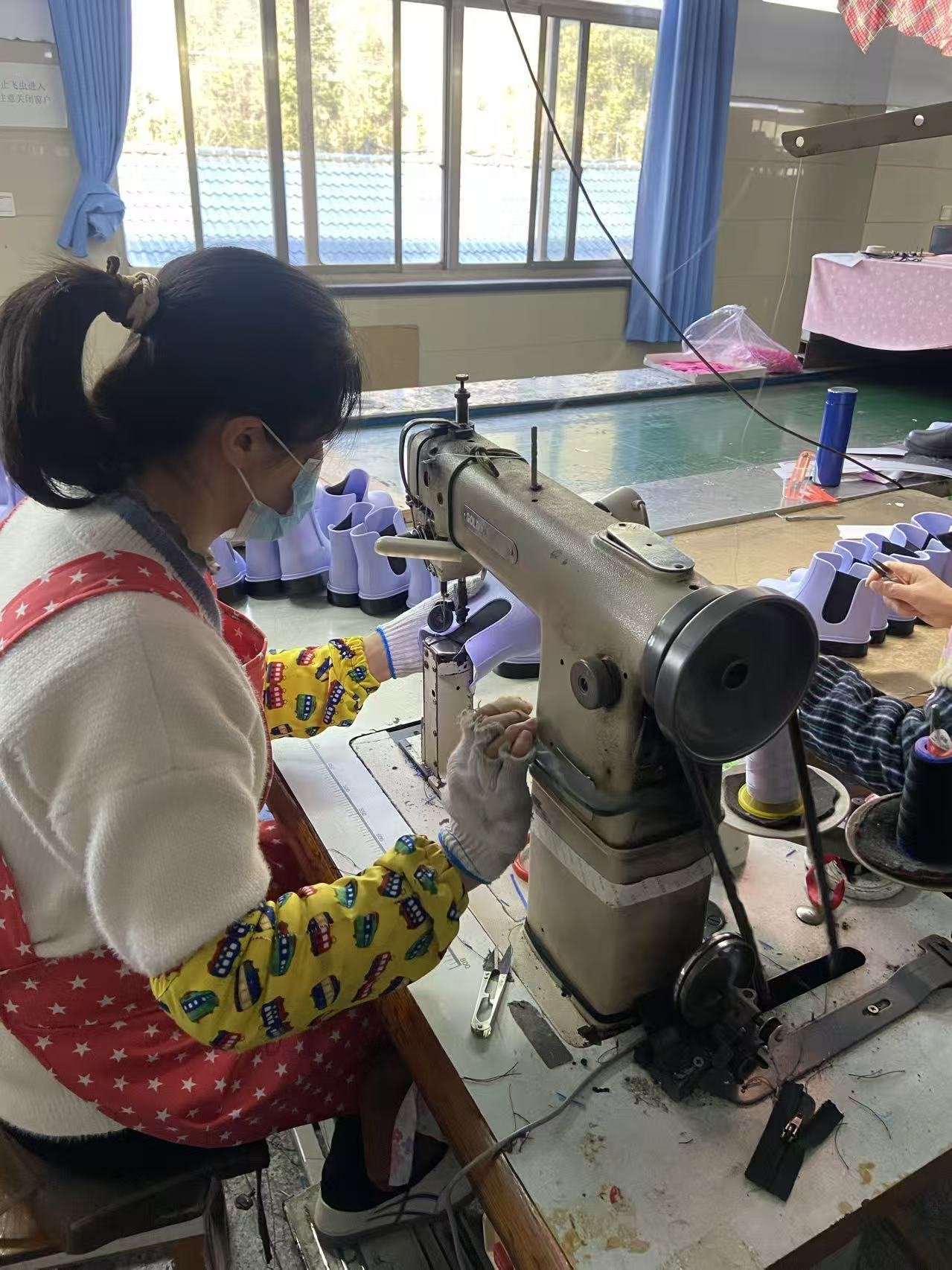
If a brand wants to develop a differentiated boot rather than select an existing product, direct communication with manufacturing and development teams may help clarify construction and production feasibility.
Custom Molds and Outsoles
Projects involving new molds, proprietary outsole patterns, or changes to the boot structure require careful coordination of tooling, sampling, and production requirements.
Detailed OEM Specifications
When an order includes specific colors, materials, logos, components, or packaging requirements, buyers need a reliable process for transferring approved specifications into production.
Long-Term Bulk Production
For repeat purchasing programs, direct production coordination may help buyers manage product revisions and maintain consistent specifications between orders.
However, working directly with a manufacturer does not eliminate the need for sample approval, quality requirements, commercial agreements, or inspection planning.
5. When Can a Broader Supplier Model Be Useful?
A sourcing supplier may be practical when a buyer needs access to multiple product categories or wants one commercial contact to coordinate several manufacturing sources.
Examples include:
- Purchasing different types of waterproof footwear
- Combining established products from several manufacturers
- Managing multiple supplier relationships through one sourcing contact
- Coordinating product selection, documentation, and shipment preparation
- Sourcing standard products without extensive proprietary development
In these situations, the supplier's coordination capability, factory relationships, and transparency can be more important than whether it directly owns every production operation.
Buyers should still confirm which factory manufactures each product and who is accountable for samples, quality control, specifications, and corrective actions.
For a more detailed comparison within the rubber boot category, read our rubber boots supplier vs manufacturer guide.
6. Compare OEM and Private Label Capabilities
Customization requirements often determine which type of supply relationship is most suitable.
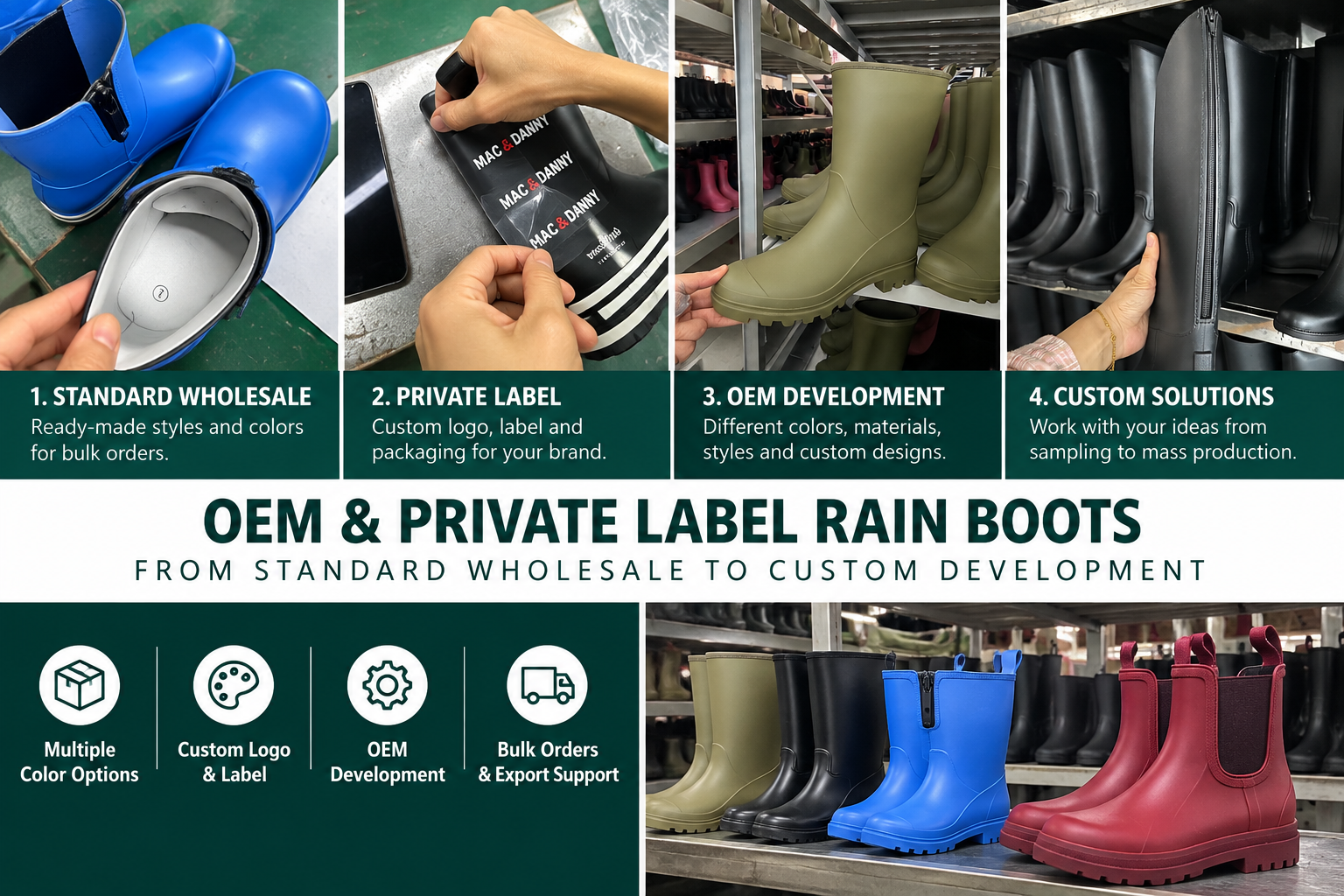
Rain boot purchasing programs can generally be divided into three levels:
Standard Wholesale Products
The buyer selects an existing product with an established design and available specifications. The main purchasing considerations are product suitability, quantity, size assortment, quality, and commercial terms.
Private Label Rain Boots
The buyer uses an existing product platform and requests selected branding changes, such as logos, colors, labels, or packaging, where supported by the product and manufacturing process.
OEM Product Development
The buyer requests more extensive development, potentially involving new tooling, outsole design, construction changes, or a proprietary product specification.
| Purchasing Model | Typical Requirements | Main Buyer Consideration |
|---|---|---|
| Standard Wholesale | Existing product and specifications | Product fit, MOQ, price, and delivery terms |
| Private Label | Existing product with selected branding | Logo, colors, packaging, and approval |
| OEM Development | Product-specific design or construction changes | Tooling, development, samples, and production control |
The right level of customization depends on the buyer's brand strategy, target market, purchasing volume, and development requirements.
Explore our OEM and customization capabilities or read our guide to custom rain boots for OEM orders to understand the options available for branded footwear programs.
7. Understand MOQ Across Different Rain Boot Categories
MOQ, or minimum order quantity, should be discussed in relation to the actual product configuration.
Buyers should confirm whether minimum quantities apply by:
- Product model
- Material or construction
- Color
- Size assortment
- Logo or branding method
- Packaging type
- Existing or new tooling
For example, a request for one existing boot design in a standard color may have a different order structure from a project involving several custom colors, new molds, and private-label packaging.
MOQ should therefore not be treated as a universal number across all rain boot manufacturers or product categories.
When requesting a quotation, provide an estimated quantity by model, color, and size. This allows the supplier to evaluate the proposed order against the relevant manufacturing requirements.
8. Who Controls Sampling and Product Specifications?
Sample development and approval are important stages in OEM and private-label sourcing.
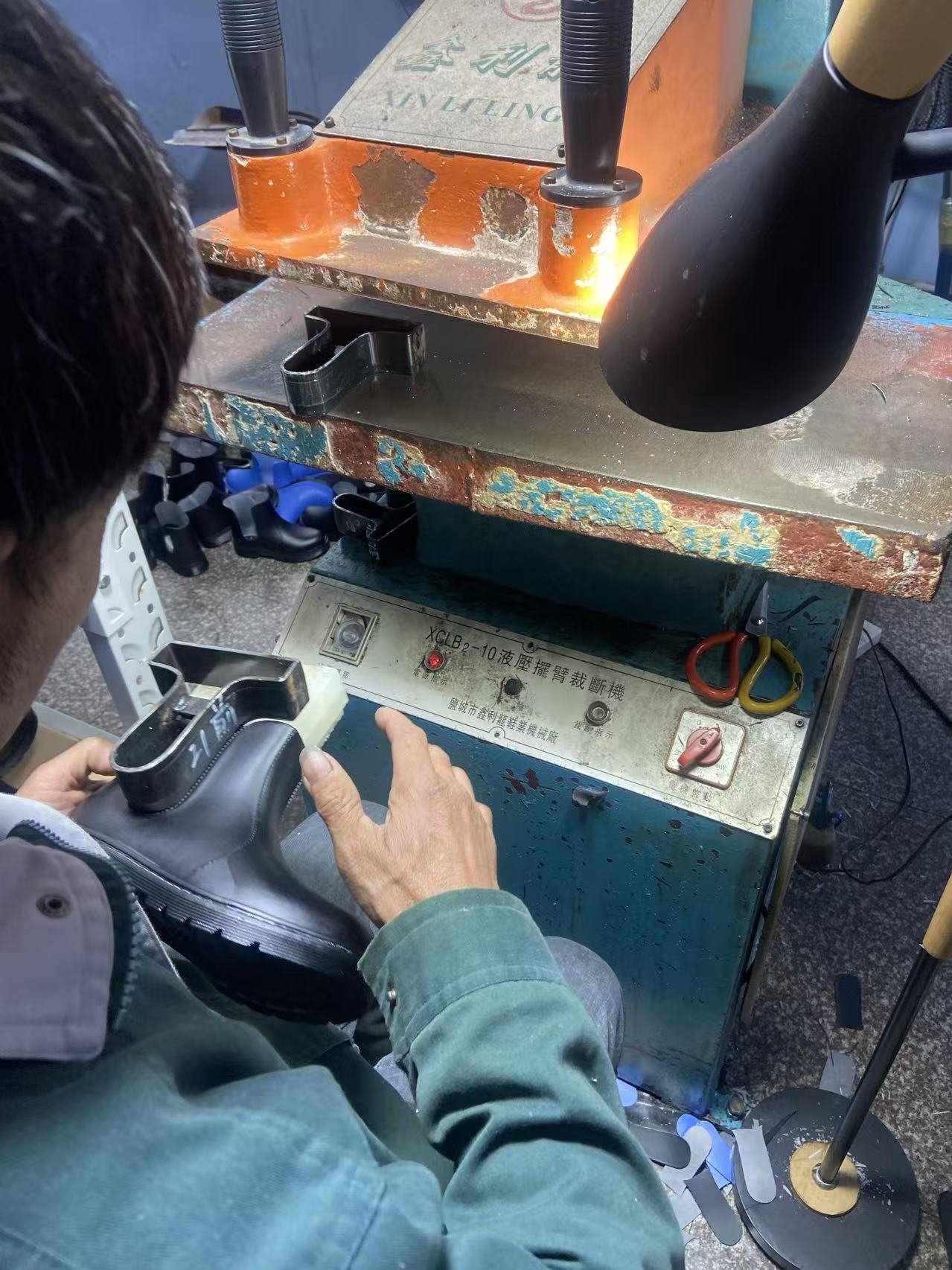
Regardless of whether the buyer works with a direct manufacturer or a sourcing supplier, the sample process should clearly establish:
- The requested product and specifications
- The sample version being evaluated
- Any required revisions
- The final approved sample
- The documented specification for bulk production
Buyers should ask who develops the samples, how revisions are communicated, and how the approved requirements reach the actual production team.
This is particularly important when the supplier coordinates production through an external factory. The buyer needs confidence that the approved sample and final specification are understood by the company manufacturing the goods.
Buyer takeaway: A physical sample and written specification should work together. An approved sample alone may not document every requirement for size assortments, colors, packaging, labeling, and future orders.
9. Quality Control, Testing and Supplier Accountability
Quality control should be evaluated as a process rather than a general promise.
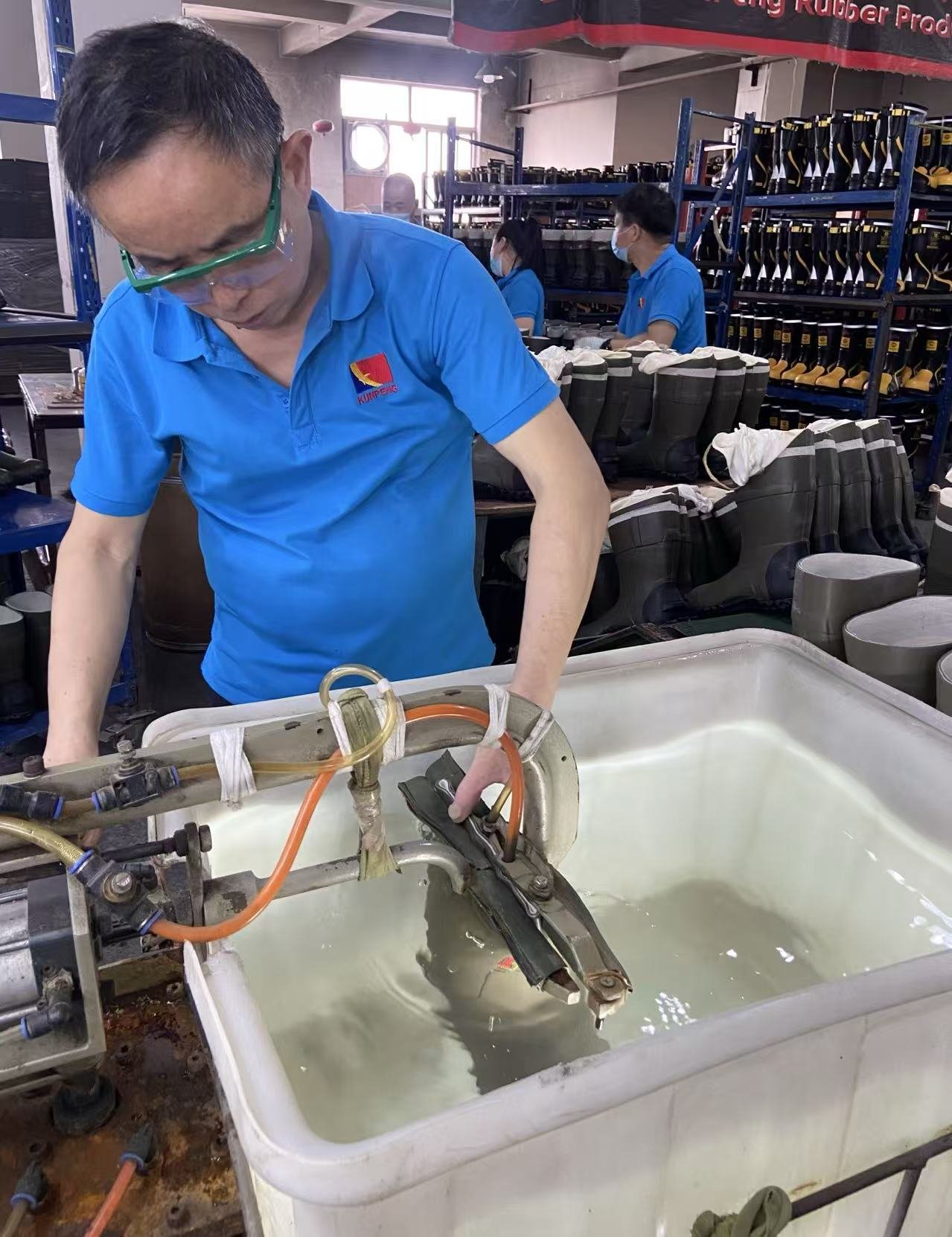
For a rain boot purchasing program, relevant inspection areas may include:
- Materials and components
- Product construction
- Size and markings
- Color consistency
- Outsole and finishing
- Appearance
- Logo and labeling
- Packaging
- Conformity with the approved specification
Where products are intended for occupational or protective use, buyers should also identify the applicable standards, testing requirements, and market-specific obligations before production.
Who Is Responsible for Quality Issues?
A useful sourcing agreement should make responsibilities clear.
Buyers should understand:
- Who defines inspection criteria?
- Who performs production and final inspections?
- How are non-conforming products identified?
- Who communicates corrective actions to the factory?
- How are issues handled before shipment?
Direct factory access can support communication, but it does not automatically guarantee quality. Similarly, an external sourcing supplier may provide effective inspection coordination if responsibilities and procedures are clearly defined.
10. Compare Quotations and Total Sourcing Requirements
When comparing rain boot manufacturers and suppliers, the lowest quoted unit price is not always the lowest total sourcing cost.
Quotations should be compared on a consistent basis, including:
- Product material and construction
- Outsole and lining requirements
- Available sizes and quantity distribution
- Colors and branding
- Tooling or mold development
- Sampling requirements
- Testing and inspection arrangements
- Packaging and carton specifications
- Order quantity
- Incoterms and shipping responsibilities
- Payment and commercial terms
For OEM projects, confirm whether tooling, sample development, testing, or customized packaging costs are included in the quotation or handled separately.
A meaningful comparison requires equivalent product specifications and clearly defined commercial responsibilities.
11. Questions to Ask a Rain Boots Manufacturer or Supplier
Before placing a bulk order, B2B buyers can use the following questions to evaluate potential partners:
- Do you manufacture the rain boots directly or work with external factories?
- Which rain boot materials and product categories do you regularly supply?
- Which manufacturing processes are performed in-house?
- What existing molds, styles, and size ranges are available?
- Can you support OEM and private-label development?
- Who manages tooling and product specifications?
- What MOQ applies to our exact product configuration?
- How are samples developed, revised, and approved?
- How is the approved specification transferred into bulk production?
- What quality-control and inspection procedures apply?
- Which testing requirements are relevant to our intended market?
- How are packaging, export documents, and shipment responsibilities handled?
- How are quality issues and corrective actions managed?
- How do you maintain product consistency for repeat orders?
Specific answers to these questions can help buyers distinguish between suppliers that merely offer a product and those whose capabilities fit the actual sourcing program.
12. Rain Boots Supplier Evaluation Checklist
Use this checklist to compare rain boot sourcing partners according to the requirements of your project.
| Evaluation Area | What B2B Buyers Should Verify |
|---|---|
| Product Category | Experience with the required rain boot type and application |
| Manufacturing Source | Who actually produces the product |
| Product Range | Relevant existing styles, sizes, and constructions |
| Materials | Material and component requirements |
| Tooling | Existing molds, new development, and responsibility |
| OEM Capability | Supported product and branding customization |
| MOQ | Minimum quantity for the actual order configuration |
| Sampling | Development, revisions, approval, and records |
| Quality Control | Production checks, final inspection, and accountability |
| Testing | Requirements relevant to the product and target market |
| Quotation | Comparable specifications, included costs, and commercial terms |
| Packaging | Labels, cartons, branding, and assortment requirements |
| Export | Documentation, shipping terms, and responsibilities |
| Repeat Orders | Specification control and production consistency |
The best sourcing partner is not necessarily the company with the broadest catalog or the lowest initial quotation. It is the one whose actual capabilities, responsibilities, and commercial terms match the buyer's requirements.
Choosing the Right Rain Boots Manufacturing Partner
Choosing between a rain boots manufacturer and supplier should begin with the product and sourcing program—not simply the company label.
For OEM and private-label projects, manufacturing access, tooling, sample development, specification control, and quality accountability can be especially important. For broader product purchasing programs, supplier coordination, product availability, and sourcing management may also provide value.
Importers, distributors, wholesalers, and brands should compare potential partners according to product suitability, manufacturing responsibility, customization capability, MOQ, quality control, and long-term supply requirements.
Jolly Boots works with B2B buyers on rain boot manufacturing and OEM projects. Explore our rain boot manufacturing capabilities, review our OEM and custom development options, or contact us with your product requirements for project evaluation.
Explore Rain Boot Manufacturing | Discuss OEM & Custom Requirements | Request a Factory Quote