Sourcing wholesale rubber boots involves more than finding a supplier with a competitive price per pair.
For importers, distributors and brands, a successful bulk order also depends on selecting the right product for the target market, understanding minimum order quantities, planning sizes and colors, confirming customization requirements, approving samples and controlling product quality.
The sourcing approach can also vary significantly between projects.
Some buyers need an existing rubber boot that can be ordered in bulk with minimal changes. Others require private-label branding, custom packaging or a more extensive OEM program.
Understanding these differences before requesting quotations can make supplier comparisons more accurate and reduce unnecessary development during the sourcing process.
This guide explains the main factors B2B buyers should consider when sourcing wholesale rubber boots for import, distribution and private-label programs.
1. What Does “Wholesale Rubber Boots” Mean for B2B Buyers?
Wholesale rubber boot sourcing can describe several different purchasing models.
Before contacting suppliers, buyers should determine how much product development and customization their project actually requires.
Existing Products for Bulk Orders
The simplest approach is to select an existing rubber boot and purchase it in bulk.
This can be suitable for importers or distributors that:
Need established product constructions
Want to reduce product development
Are testing a new market or category
Do not require extensive customization
Available colors, sizes, packaging and other options will depend on the specific product and supplier.
Private Label Rubber Boots
Private-label sourcing typically starts with an existing product but adds branding or market-specific presentation.
Depending on the product, customization may include:
Logo
Color
Labels
Hangtags
Packaging
Carton markings
This approach can help brands and distributors build their own product line without developing every component from the beginning.
OEM Rubber Boots
OEM projects may involve more extensive changes to the product itself.
Depending on the requirements, this can include changes to:
Product construction
Outsole
Dimensions
Components
Molded details
Tooling
Packaging
OEM development can provide greater product differentiation, but it may also involve additional development, tooling, sampling and minimum order requirements.
The right sourcing model therefore depends on the buyer’s target market, order volume, product requirements and desired level of differentiation.
2. Choose Rubber Boots for the Target Market
Before selecting products from a supplier’s catalog, buyers should define where and how the rubber boots will be sold or used.
The same product may not be suitable for every market.
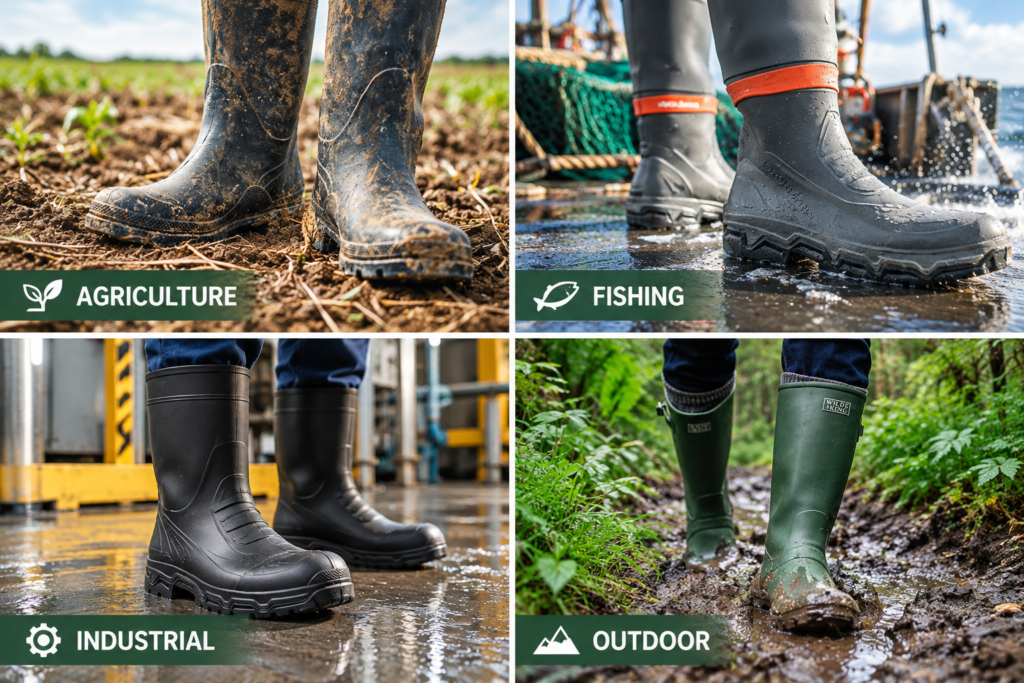
Agriculture and Farming
Rubber boots for agricultural markets may be used in muddy fields, livestock operations, irrigation work and other wet environments.
Depending on the application, buyers may consider factors such as:
Boot height
Outsole design
Ease of cleaning
Flexibility
Durability
Fit and comfort
Fishing and Marine Markets
Fishing, seafood processing and marine applications often involve wet working environments.
Product selection may therefore place greater emphasis on:
Waterproof construction
Outsole
Wet-surface performance
Ease of cleaning
Boot height
Working comfort
Industrial and Work Applications
Rubber boots intended for industrial or occupational environments may require different product features depending on the workplace.
Where protective or safety claims are involved, buyers should also identify the applicable requirements for the intended market before ordering.
Outdoor and General-Purpose Markets
For outdoor retail or general waterproof use, priorities may shift toward:
Weight
Flexibility
Color selection
Styling
Comfort
Packaging
Retail positioning
Start With the Market, Not the Catalog
A large supplier catalog can provide useful options, but buyers should not select products based only on appearance.
Start by defining:
Who will use the boots?
Where will they be used?
What product characteristics matter in that environment?
What price and market position are being targeted?
The answers make it easier to narrow a large product range into a smaller group of commercially relevant options.
3. Manufacturer vs Wholesale Supplier
B2B buyers may source rubber boots from manufacturers, wholesalers, trading companies or other types of suppliers.
The appropriate sourcing channel depends on the order.
Direct Manufacturer
Working with a manufacturer may be relevant when buyers need:
Direct manufacturing relationships can be particularly useful when a distributor or brand plans to develop a long-term product program rather than make a one-time purchase.
Wholesale Supplier
A wholesale supplier may be suitable when the main requirement is purchasing existing products with limited development.
Depending on the supplier’s business model, this may provide access to established products or different purchasing arrangements.
However, buyers should confirm who actually manufactures the footwear when production control, OEM development or product-specific documentation is important.
Choose Based on the Purchasing Program
Neither business model should be evaluated only by its label.
The important questions are:
What product do you need?
How much customization is required?
What quantities will you purchase?
Will the product be reordered?
Who controls manufacturing and quality?
Who is responsible for product changes?
The sourcing channel should fit the commercial requirements of the purchasing program.
If direct manufacturing is important to your sourcing program, see our guide on how to choose a rubber boots manufacturer for your brand.
4. Understand MOQ Before Requesting a Quote
Minimum order quantity is one of the first questions many wholesale buyers ask.
However, asking only “What is your MOQ?” may not provide enough information to plan a real order.
The useful MOQ is the minimum quantity for your actual product configuration.
MOQ Can Depend on the Product
Minimum quantities may vary according to factors such as:
Boot model
Construction
Existing molds
Size range
Color
Logo
Packaging
Custom components
New tooling
An existing product with standard specifications may have different production requirements from a customized OEM product.
Ask About MOQ Per Color
Suppose a buyer plans to order 1,200 pairs in four colors.
A supplier may not necessarily treat this as a single 1,200-pair production quantity.
The buyer should confirm whether minimum quantities apply to each color or production configuration.
Ask About Size Requirements
Footwear orders normally contain multiple sizes.
Before confirming the order, determine:
Packaging Can Have Separate Minimums
Custom boxes, printed bags, labels and other packaging components may have production minimums that differ from the footwear itself.
This should be confirmed before finalizing the packaging design.
Request MOQ for the Complete Order Configuration
Instead of asking only:
“What is your MOQ?”
Provide the supplier with:
The supplier can then evaluate a minimum order based on a much more realistic production scenario.
5. Plan Sizes, Colors and SKUs Before Ordering
Wholesale footwear orders can become complex quickly when multiple sizes and colors are involved.
For importers and distributors, SKU planning should therefore begin before the purchase order is finalized.
One Product Can Create Many SKUs
For example, a rubber boot offered in:
can create up to 24 size-and-color combinations.
Adding more product models increases the number further.
This matters because the total order quantity must be distributed across those combinations.
Avoid Dividing Quantities Equally Without Market Data
Not every size or color will sell at the same rate.
Where possible, buyers should use information from:
Previous sales
Distributor feedback
Customer orders
Comparable footwear
Target-market sizing
to build the assortment.
A simple equal quantity for every size may not reflect actual demand.
Keep the First Order Manageable
When testing a new market, offering too many colors or product variations can spread the order quantity across too many SKUs.
This may create:
A focused assortment can make the initial wholesale program easier to manage.
Plan for Reorders
The first order should not be considered in isolation.
Importers and distributors should also consider:
Which sizes are likely to sell fastest?
Which colors are core products?
How will reorders be structured?
Can the same product specification be repeated?
How will product codes and packaging identify each SKU?
Good assortment planning can make both the first shipment and future replenishment more efficient.
6. Standard Wholesale vs Private Label vs OEM
The level of customization has a major influence on how a wholesale rubber boot program should be planned.
Buyers can generally think about sourcing in three broad models.
| Sourcing Model | Product Base | Branding | Product Development | Often Suitable For |
|---|
| Standard Wholesale | Existing product | Limited or none | Low | Market testing and straightforward bulk purchasing |
| Private Label | Existing product or construction | Logo, labels and packaging | Low to moderate | Brands, importers and distributors |
| OEM | Existing or newly developed construction | Customized branding | Moderate to extensive | Differentiated product programs |
Standard Wholesale
Standard wholesale purchasing focuses mainly on existing products.
This can reduce development requirements and may be appropriate when the buyer’s priority is bringing an established product to market.
Private Label
Private-label programs allow buyers to create a branded product without necessarily developing a completely new boot.
Depending on the product, this may include:
Custom colors
Logo
Labels
Hangtags
Packaging
Carton markings
OEM Development
OEM sourcing becomes more relevant when the buyer requires greater product differentiation.
Depending on the project, development may involve:
More extensive customization may also affect development time, samples, MOQ and cost.
The right model is not necessarily the one with the most customization.
It is the one that provides the level of product differentiation required by the target market without adding unnecessary development.
OEM rain boot manufacturing
For a detailed breakdown of available branding and product options, see what B2B buyers can customize for OEM rain boot orders.
7. Review Samples Before Placing a Bulk Order
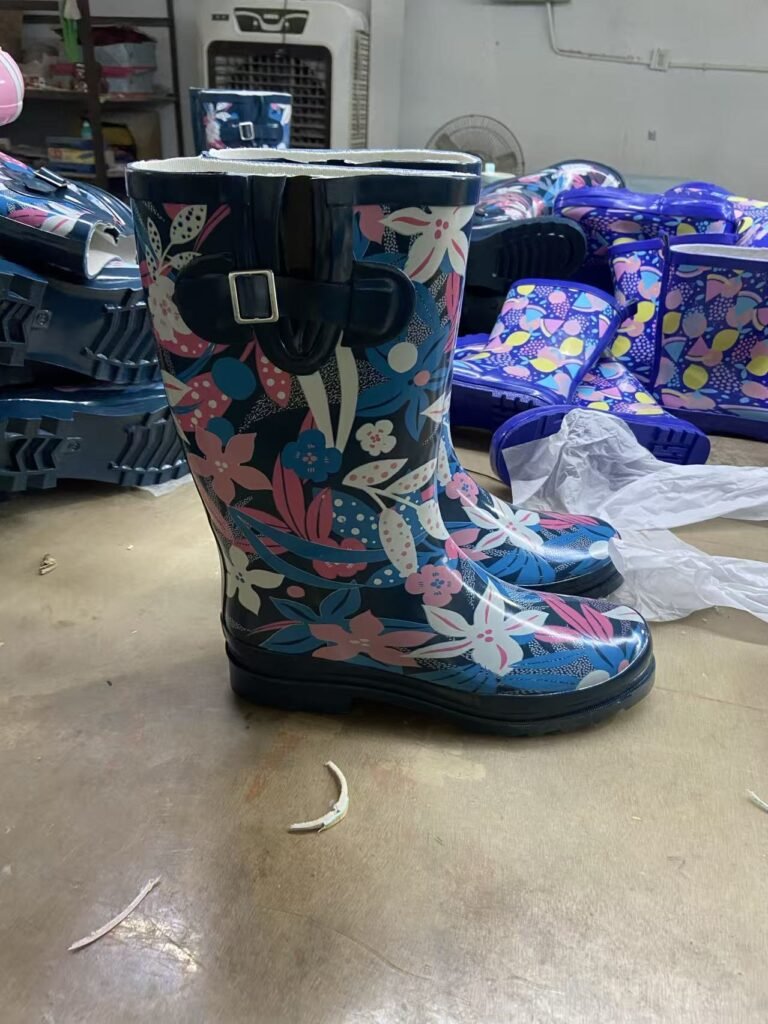
Samples allow wholesale buyers to evaluate the physical product before committing to a larger order.
This is particularly important when the product will be distributed under the buyer’s own brand.
Evaluate the Product
Depending on the intended market, buyers may review:
Overall construction
Appearance
Material feel
Weight
Flexibility
Boot height
Outsole
Size and fit
Color
Finishing
The objective is to determine whether the product is suitable for the intended customer and application.
Evaluate Branding and Packaging
For private-label orders, the sample stage should also confirm relevant branded elements.
These may include:
Logo
Label
Hangtag
Packaging
Product information
Carton requirements
Digital artwork alone may not show exactly how these elements will appear on the finished product.
Evaluate the Product Commercially
Importers and distributors should also look at the sample from the perspective of the target market.
Ask:
Does the product fit the intended price segment?
Is the design appropriate for the customer?
Is the weight suitable for the market?
Does the packaging match the sales channel?
Is the product differentiated enough from competing options?
A technically acceptable product is not automatically the right commercial product.
Approve a Clear Reference
Once the sample is accepted, the buyer and supplier should confirm the final product specification.
The approved sample and documented specification can then provide a reference for bulk production and inspection.
8. Compare Wholesale Rubber Boot Quotations Correctly
The lowest quoted price is not always the lowest-cost sourcing option.
Before comparing prices from different rubber boot suppliers, buyers should first confirm that the quotations describe substantially the same product and commercial requirements.
Compare the Product Specification
Check whether each quotation is based on comparable:
Product construction
Materials
Boot height
Outsole
Lining
Components
Size range
Color requirements
A difference in product specification can create a legitimate difference in price.
Compare Customization
Confirm whether the quotation includes:
Do not assume these are automatically included in the unit price.
Separate Product Cost From Development Cost
For OEM projects, additional costs may include:
Tooling
New molds
Sample development
Packaging setup
Testing
These should be understood separately from the regular bulk unit price where applicable.
Check the Commercial Terms
Buyers should also compare:
MOQ
Payment terms
Quotation validity
Production assumptions
Packaging
Delivery terms
Applicable Incoterm
A price quoted under one delivery term should not be compared directly with another without accounting for the difference.
Compare Like With Like
A useful supplier comparison should answer:
“What exactly am I receiving for this price?”
Two quotations are meaningfully comparable only when the underlying product, customization and commercial requirements are sufficiently similar.
9. Plan Quality Control for Wholesale Rubber Boots
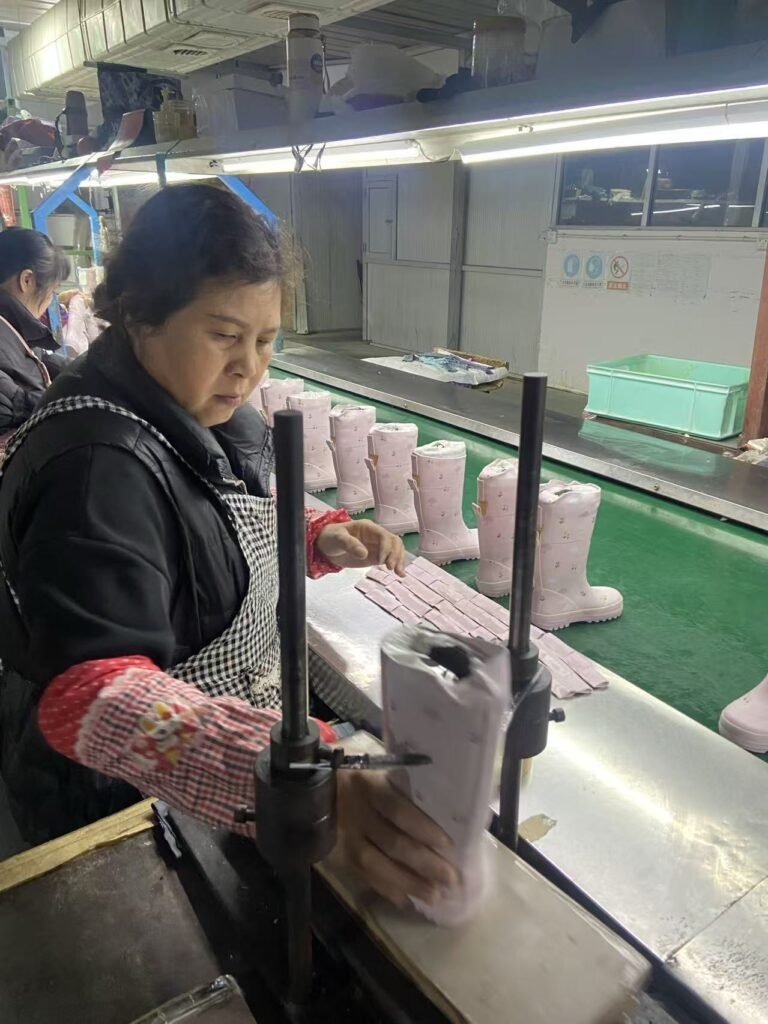 Quality requirements should be established before bulk production rather than discussed only after the order is finished.
For wholesale buyers, consistency across sizes, colors and production quantities is especially important.
Use the Approved Product as a Reference
The approved sample and final specification should identify the main requirements for the order.
Depending on the product, these may include:
Construction
Appearance
Color
Size
Logo
Outsole
Components
Packaging
Check Bulk Order Consistency
Wholesale orders can contain many pairs across multiple sizes and SKUs.
Inspection should therefore consider whether the production remains consistent across the order.
Relevant checks may include:
Correct model
Size markings
Pair matching
Color
Branding
Finishing
Packaging
Quantity
Identify Product-Specific Testing Requirements
Testing requirements should be determined according to the intended application, destination market and product claims.
A general-purpose rubber boot and a product marketed with occupational or protective claims may have different requirements.
Where specific compliance is required, buyers should confirm the applicable requirements before production.
Do Not Treat Quality Control as a Final-Step Problem
Final inspection is important, but quality control is more effective when key requirements are also monitored during production.
Clear specifications, approved samples and appropriate in-process checks can reduce the risk of discovering significant problems only after the full order has been completed.
For products with occupational or protective claims, read our guide to safety standards for OEM rain boot manufacturing.
10. Plan Packaging, Shipping and Repeat Orders
A wholesale sourcing program does not end when the boots leave the production line.
Packaging, shipment preparation and repeat-order planning can affect how efficiently the products move through the buyer’s distribution network.
Define Packaging Requirements
Depending on the sales channel, buyers may need:
Individual bags
Retail boxes
Labels
Hangtags
Size identification
Barcodes
Inner cartons
Export cartons
Shipping marks
These requirements should be discussed early because custom packaging may affect cost, MOQ and production planning.
Make SKUs Easy to Identify
When an order contains multiple sizes and colors, clear identification becomes important.
Cartons should be organized according to the agreed packing plan so that importers and distributors can identify the contents efficiently after arrival.
Confirm Shipping Responsibilities
Before placing the order, buyers should understand:
The exact responsibilities depend on the commercial terms agreed between buyer and supplier.
Think Beyond the First Order
For distributors and brands, a successful first shipment is often the beginning of a longer sourcing program.
Before finalizing the product, consider:
Can the same construction be reordered?
Will the molds remain available?
Can colors and branding be reproduced consistently?
How will specifications be controlled between orders?
How will fast-selling sizes be replenished?
Will packaging remain consistent?
The ability to repeat a successful product can be just as important as completing the initial bulk order.
A wholesale rubber boot program should therefore be planned around both the first shipment and future replenishment.
11. Wholesale Rubber Boots Sourcing Checklist