The first step is to confirm whether the supplier actually manufactures PVC boots in-house or mainly sources products from other factories.
This distinction does not automatically mean that one type of supplier is better than another, but it affects how much control the supplier may have over production schedules, tooling, product modifications and quality consistency.
For buyers who need OEM or private-label PVC rain boots, it is useful to verify several areas of the factory before moving forward.
Check the Production Equipment
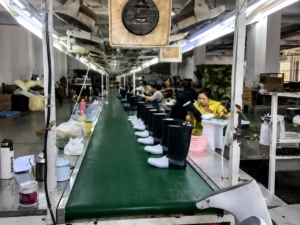
PVC rain boots are commonly produced through injection-molding processes. A manufacturer should be able to explain what production equipment it uses, what types of boots can be produced on the lines and how different molds or materials are handled.
Buyers can ask questions such as:
How many PVC injection-molding lines are currently in operation?
Which boot heights and constructions can be produced?
Can existing molds be used for new orders?
Can the factory develop new molds for custom projects?
How is production capacity allocated during peak seasons?
The goal is not simply to collect a list of machines. Buyers should understand whether the production setup matches the product they plan to order.
Review the Mold and Tooling Capability
Molds have a direct impact on boot shape, size range, outsole design and customization possibilities.
If a buyer wants a standard product with a custom logo or color, an existing mold may be sufficient. A more customized design may require tooling changes or a completely new mold.
Before confirming an OEM project, buyers should clarify:
Which molds are already available
Which size ranges each mold supports
Whether outsole patterns can be changed
Whether logos can be molded or embossed
What additional cost and lead time are required for new tooling
This information helps avoid unexpected charges after product development has already started.
Inspect the Production and QC Areas
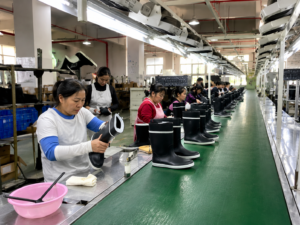
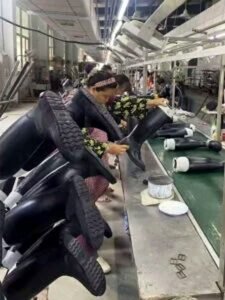
A real manufacturing operation should normally have visible areas for production, material handling, quality inspection, finished goods and packing.
If possible, buyers should request current factory photos, production videos or a live video call. During a factory visit or remote review, look for evidence of active production rather than only sample rooms or product displays.
Useful areas to check include:
Raw material storage
Injection-molding production
Trimming and finishing
In-line inspection
Finished boot inspection
Packing and warehouse areas
These details provide a clearer picture of how the supplier manages orders from production to shipment.
Ask Who Controls the Production Process
Another useful question is whether key production stages are handled internally or outsourced.
For example, a supplier may manufacture the PVC boot body in-house but outsource packaging, accessories or certain finishing processes. Outsourcing itself is not necessarily a problem, but the buyer should understand who is responsible for quality control and delivery at each stage.
The most important point is transparency. A reliable supplier should be able to explain where the product is made, how it is inspected and who is responsible when a specification needs to be adjusted.
Buyers who want to review available constructions, customization options and bulk-order capabilities can also explore our PVC rain boots manufacturing capabilities.
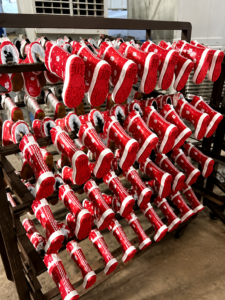
A manufacturer’s product range can reveal more than the number of boot styles in its catalog. It can also help buyers understand the factory’s experience with different molds, boot constructions, outsole designs and end-use requirements.
Before selecting a supplier, compare its existing product range with the type of PVC boots you plan to source.
Buyers can compare different PVC rain boot styles and manufacturing options before deciding whether an existing construction or a new OEM design is more suitable.
Look for Experience in Your Product Category
PVC boots can be designed for very different working environments. A factory producing general-purpose Wellington boots may have different product experience from one manufacturing safety, agricultural or commercial fishing footwear.
Depending on your market, relevant product categories may include:
PVC safety boots for industrial and construction environments
PVC work boots for factories, cleaning and general wet-work applications
PVC farm boots for agriculture, livestock and muddy conditions
PVC fishing boots for commercial fishing, aquaculture and seafood processing
PVC Wellington boots for wholesale and private-label programs
Lightweight PVC rain boots for general work and outdoor applications
A broad range is useful, but the number of styles alone should not determine your supplier choice. More importantly, the manufacturer should understand the construction and performance requirements of the specific product you need.
Compare Existing Products With Your Requirements
Using an existing product as the starting point for an OEM project can often simplify development.
For example, if the factory already has a suitable boot height, size range and outsole construction, a buyer may only need to customize the color, logo or packaging. This can be more straightforward than developing a completely new boot from the beginning.
When reviewing existing products, compare:
Boot height and overall shape
Available size range
Outsole pattern and intended use
Toe protection requirements
Boot weight and flexibility
Lining or interior construction
Existing molds and tooling
Available customization options
If an existing construction is close to the required product, ask the manufacturer which elements can be modified without developing a new mold.
Consider the Intended Application
The same PVC material category can be used for boots serving very different applications.
For example, an agricultural buyer may prioritize easy cleaning, durability and traction in muddy environments. A seafood-processing buyer may be more concerned about wet-floor grip and frequent washing. An industrial buyer may need additional protective features depending on the workplace.
For this reason, buyers should describe the intended application rather than simply sending a request for “PVC rain boots.”
Useful information to provide includes:
Where the boots will be used
Typical working conditions
Required protection features
Target market or country
Expected order quantity
Preferred boot height and style
Any special outsole or material requirements
This gives the manufacturer a better basis for recommending an existing model or proposing a customized construction.
Do Not Choose by Catalog Size Alone
A large catalog does not necessarily mean that every product is manufactured regularly or that every mold is currently available.
Ask which models are active production items, which molds are available and which products the factory has recent manufacturing experience with.
For B2B sourcing, a smaller selection of proven constructions can sometimes be more useful than hundreds of catalog images with limited production history.
The objective is to find a manufacturer whose existing capabilities are close to your product requirements and who can clearly explain what can be customized for your project.
For private-label brands, importers and distributors, “OEM available” is not enough information. Buyers should confirm exactly which parts of a PVC boot can be customized, what changes can use existing tooling and which modifications require new molds or additional development.
Clarifying these details early can prevent unexpected costs, higher MOQs or longer lead times later in the project.
Identify What Can Be Customized
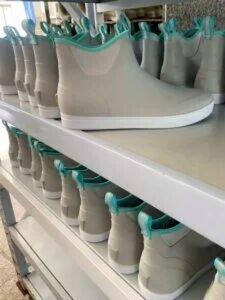
Depending on the boot construction and available tooling, common OEM options may include:
Boot and outsole colors
Printed, embossed or molded logos
Boot height
Outsole pattern
Size range
Lining or interior details
Labels and hangtags
Individual packaging
Export cartons
Private-label branding
However, not every customization has the same impact on production.
Changing a boot color, for example, may be relatively straightforward when an existing mold is used. Changing the shape of the boot or developing a proprietary outsole normally requires more tooling work.
Buyers should therefore separate cosmetic customization from structural customization when discussing a project.
Ask Whether Existing Molds Can Be Used
Existing molds can often reduce development time and initial tooling costs.
If the factory already produces a boot with the required height, shape and outsole, buyers may be able to create a differentiated product through color, branding, packaging or other modifications without developing a completely new construction.
Before requesting a new mold, ask:
Is there an existing model close to our design?
Which parts can be modified with the current mold?
Can our logo be added to the existing construction?
Does customization affect the available size range?
What changes would require new tooling?
For new brands or initial market tests, adapting an existing construction may offer a lower-risk way to start an OEM program.
Understand When a Custom Mold Is Necessary
A new mold may be appropriate when the buyer needs a proprietary boot shape, unique outsole, special dimensions or design features that cannot be achieved with existing tooling.
Before approving new tooling, confirm the development process, tooling cost, expected lead time and ownership arrangements.
The buyer should also clarify how samples will be produced and approved before bulk manufacturing begins.
A custom mold can provide greater product differentiation, but it should be based on a clear commercial requirement rather than customization for its own sake.
Define Branding and Packaging Requirements Early
Private-label projects often involve more than putting a logo on the boot.
Branding requirements may include boot logos, size labels, hangtags, polybags, individual boxes, master cartons and shipping marks. These details can affect quotation, MOQ and production preparation.
When requesting a quotation, provide available artwork and packaging requirements as early as possible.
A clear OEM specification allows the manufacturer to quote the project more accurately and reduces the risk of changes after sampling has started.
Planning a Custom PVC Boot Project?
Review available colors, logos, outsoles, molds and packaging options for your bulk order.
A sample allows buyers to verify whether the proposed PVC boot matches the agreed specifications before committing to bulk production.
The purpose of sampling is not only to check how the boot looks. A useful sample review should cover construction, dimensions, materials, branding and the features that matter for the intended application.
Confirm What Type of Sample You Are Receiving
Not all samples represent the same stage of product development.
A supplier may provide an existing stock sample to demonstrate general workmanship, while an OEM project may later require a customized sample with the selected color, logo, outsole or packaging.
Before evaluating a sample, clarify whether it is:
An existing reference sample
A sample made from an existing mold
A customized pre-production sample
A sample produced from newly developed tooling
This prevents misunderstandings about which features will appear in the final bulk order.
Check the Product Against the Specification
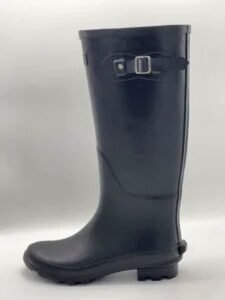
Create a simple checklist before reviewing the sample.
Depending on the product, buyers may need to check:
Boot height and overall dimensions
Size and fit
Weight
PVC flexibility and feel
Surface finish and appearance
Color consistency
Outsole pattern
Toe construction
Logo position and appearance
Lining or internal finish
Packaging and labeling
Compare these details with the quotation, drawings, specification sheet or other requirements agreed with the supplier.
Do not rely only on photographs when dimensions, materials or functional details are important.
Evaluate the Boot for Its Intended Use
The sample should also be reviewed in the context of its actual application.
A farm boot, for example, may require suitable traction and easy cleaning. A fishing or seafood-processing boot may be exposed to continuously wet working conditions. A safety-oriented product may have additional protection or testing requirements.
Tell the manufacturer how the product will be used so that both sides understand which characteristics are critical.
If specific performance or compliance testing is required, agree on the test method and acceptance criteria before bulk production.
For safety-oriented products, buyers should also understand how safety standards can affect OEM rain boot development and testing requirements.
Record Sample Changes Clearly
If the first sample requires changes, provide structured feedback rather than general comments such as “make it better” or “change the shape.”
Where possible, identify the exact item to be modified and provide measurements, reference images, color codes or annotated photographs.
For example:
Increase shaft height by a specified amount
Adjust the Pantone color
Move the logo to a defined position
Change the packaging label
Modify a specific outsole detail
Clear feedback reduces repeated sampling and helps both buyer and manufacturer work from the same specification.
Approve a Reference Before Bulk Production
Once the final sample meets the agreed requirements, confirm which version will serve as the production reference.
The approved sample, together with the final specification, artwork and packaging requirements, gives the factory a clear standard for bulk manufacturing and inspection.
Any changes made after approval should be documented rather than communicated only through informal messages.
A well-managed sample approval process can reduce misunderstandings and make final inspection more objective because both sides have already agreed on what the finished product should be.
Quality control should be evaluated as a process rather than a final inspection performed just before shipment.
For PVC rain boots, problems can originate from materials, molding, finishing, sizing, branding or packaging. A manufacturer should be able to explain when these items are checked and how non-conforming products are handled during production.
Ask About Incoming Material Control
Quality management begins before molding starts.
Buyers should ask how the factory manages incoming PVC compounds, packaging materials, labels and other components used for the order.
For customized projects, the manufacturer should also have a clear method for confirming approved colors, artwork and other order-specific materials before they enter bulk production.
The objective is to prevent incorrect materials or specifications from moving further into the production process.
Review In-Process Inspection
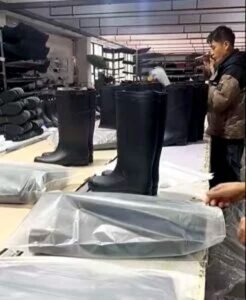
Inspection during production can identify problems earlier than a final check after the entire order has been completed.
Depending on the boot and production process, in-process checks may cover:
Molding appearance
Surface defects
Boot shape
Size markings
Color consistency
Outsole formation
Trimming and finishing
Logo placement
Ask who performs these checks, how frequently they are carried out and what happens when a problem is found.
A useful quality-control system should not depend entirely on discovering defects at the end of production.
Confirm Waterproof and Functional Checks
Waterproof performance is a basic expectation for PVC rain boots, but additional checks may depend on the product’s intended use.
Buyers should clarify how the manufacturer verifies waterproof integrity and whether additional functional testing is required for the order.
For products with safety or application-specific requirements, testing should be based on the relevant specification or agreed standard rather than general claims such as “high quality” or “heavy duty.”
Understand the Final Inspection
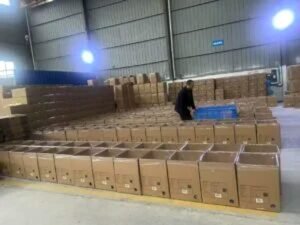
Before shipment, the finished order should be checked against the approved product and purchase requirements.
Final inspection may include:
Product appearance
Quantity
Size assortment
Color
Branding
Packaging
Carton markings
Workmanship
Agreed functional requirements
For larger or higher-risk orders, buyers may also choose to arrange an independent third-party inspection before shipment.
Agree on Acceptance Criteria Before Production
One of the most effective ways to reduce quality disputes is to define important requirements before bulk production begins.
The purchase specification, approved sample, artwork, packaging instructions and agreed inspection criteria should provide a common reference for both parties.
This makes quality control more objective and helps the manufacturer understand which product characteristics are critical to the buyer.
Price is important, but it should not be the only factor used to compare PVC rain boot suppliers.
Sampling delays, unclear specifications, packaging errors or missed production schedules can create costs that are much larger than a small difference in unit price. Buyers should therefore evaluate how the supplier manages the complete order process.
Separate Sampling Time From Production Lead Time
When asking about delivery, clarify what the quoted lead time actually includes.
A typical OEM project may involve several stages:
Requirement confirmation
Quotation
Artwork or specification approval
Sample preparation
Sample revision, if required
Final sample approval
Material preparation
Bulk production
Final inspection
Packing and shipment preparation
A production lead time should normally be understood from an agreed starting point, such as final sample approval and confirmation of the required order conditions.
This makes delivery estimates easier to compare between suppliers.
Evaluate Relevant Export Experience
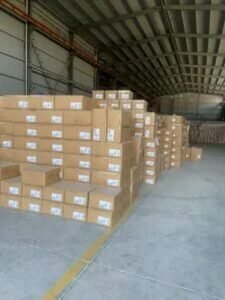
Export experience can be useful when a manufacturer understands the documentation, packaging and shipment coordination required for international orders.
However, the number of countries supplied should not be the only measure of capability.
Ask whether the manufacturer has experience with:
Your destination market
Similar PVC boot products
Export carton and labeling requirements
Commercial documentation
Inspection arrangements
Shipment coordination
Experience with a similar product and market may be more relevant than a large general export figure.
Pay Attention to Communication Quality
Many sourcing problems begin with incomplete or misunderstood specifications.
During the quotation and sampling stages, evaluate whether the supplier:
Answers technical questions clearly
Confirms specifications in writing
Identifies missing information
Explains limitations before production
Provides realistic lead times
Records requested changes
Responds consistently during product development
Fast replies are useful, but accuracy is more important than speed alone.
A supplier that asks detailed questions about application, quantity, sizing, customization and target market may ultimately reduce more risk than one that sends an immediate quotation without clarifying the project.
Compare Total Sourcing Risk, Not Only Unit Price
When comparing quotations, consider the complete sourcing picture:
Unit price
Tooling cost
Sample cost
MOQ
Quality-control process
Testing requirements
Packaging
Production lead time
Communication
Export support
A slightly lower unit price can quickly lose its advantage if the order requires repeated sampling, rework, delayed shipment or corrective action.
The objective is to choose a supplier that can deliver the required product consistently at a commercially workable total cost.